








Particle Clicker
Particle Clicker builds its entire endgame around one historical event: the Higgs boson discovery, the final missing particle of the Standard Model, confirmed in 2012 and recreated here as the ultimate research goal sitting at the end of the game's research tree. Everything before that moment - every click, every hire, every grant - is built to walk a player through a condensed, playable version of how modern particle physics actually got there.
| Genre | Idle / Incremental Clicker (Educational) |
|---|---|
| Core Action | Clicking the detector to generate collision data |
| Currency | Data and Reputation |
| Staff Tiers | PhD Students, Postdocs, Supercomputers |
| End Goal | The Higgs Discovery |
Data, Collisions, and the Core Loop of Particle Clicker
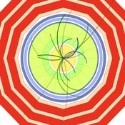
Every run of Particle Clicker starts with a single click on a stylized particle detector modeled after the kind of device used at the Large Hadron Collider. Each click triggers a simulated collision, scattering particles across the screen and producing Data, the game's core currency. That Data gets spent on research - unlocking the discovery of real particles from the history of physics - while a separate pool of funding, earned through CERN Grants, pays for staff and equipment.
New players tend to treat clicking as the main source of progress for far longer than the game actually rewards, since a single Junior Researcher clicking by hand simply cannot keep pace with the amount of Data later research tiers demand. The real turning point comes once a player realizes that hiring staff to collect Data automatically matters more than click speed ever will.
What makes Particle Clicker distinct from other clicker games built on the same Cookie Clicker template is that the pacing isn't arbitrary - the quantity of Data required for each new discovery increases in a way that mirrors how genuinely data-intensive modern particle physics research actually is, so the grind isn't just padding, it's a loose simulation of the real scientific bottleneck.
The detector itself is the detail that sells that simulation. Every click sends a small shower of simulated particle tracks scattering outward across the image, mimicking what an actual collision event display looks like in a physics lab rather than a cartoon icon bouncing in place. It's a small touch, but it's the one players who've spent real time with the game mention first - the detector visibly reacts in a way that ties the clicking motion back to the subject matter instead of feeling arbitrary, which is exactly why Particle Clicker reads less like a parody of Cookie Clicker and more like an homage built around a subject serious enough to justify borrowing the format wholesale.
Starting as a Junior Researcher in Particle Clicker
Every save file in Particle Clicker begins the same way: a single Junior Researcher, a basic accelerator, and no discoveries to your name. There's no choice of specialization or starting bonus to pick from - the game wants every player to feel the same slow, manual grind before automation becomes an option, which is a deliberate echo of how a real research career actually starts small before scaling up.
Clicking as that lone Junior Researcher is enough to fund the earliest accelerator upgrades, which increase how much Data each click produces rather than adding new automated staff. It's a short phase, usually lasting only a few minutes, but it's the part of the game most directly responsible for teaching the clicking rhythm the rest of the systems build on top of.
Early in the game, before any real staff have been hired, progress feels almost entirely dependent on how often you're willing to click. That changes fast once the first PhD Student is affordable, and the shift from solo clicking to a staffed lab is one of the more satisfying early transitions in the genre precisely because the game telegraphs it so clearly - the moment hired staff start producing Data without input, the lone Junior Researcher stops carrying the whole lab alone.
PhD Students, Postdocs, and Supercomputers in Particle Clicker
Automation in Particle Clicker comes from hiring staff, and each tier produces Data at a dramatically different rate. A PhD Student contributes about 1 tap's worth of Data per second on their own, which is a useful but modest boost early on. Postdocs outproduce them at roughly 5 taps per second each, and Supercomputers leap far ahead of both, each one worth around 100 taps per second once purchased.
That jump between tiers is deliberate, and it's also where a lot of players get the spending order wrong. Pouring every early grant into Postdocs before a solid base of PhD Students is established tends to slow things down rather than speed them up, since the cheaper hires are what fund the expensive ones in the first place.
The staff tiers that carry a run from the opening clicks to the later research stages are:
- PhD Students - roughly 1 tap per second of Data each, the cheapest automation available
- Postdocs - roughly 5 taps per second each, a solid mid-tier investment
- Supercomputers - roughly 100 taps per second each, the backbone of late-game Data production
Players who enjoy Particle Clicker's management side tend to be the ones who treat staffing almost like a budget spreadsheet, constantly recalculating whether the next Postdoc or Supercomputer purchase pays for itself faster than simply waiting.
CERN Grants and Growing Your Research Team
Reputation is the quieter of Particle Clicker's two currencies, but it's just as important as Data. Every particle you successfully research raises your reputation, and higher reputation unlocks bigger CERN Grants, which is the funding that actually lets a player afford more PhD Students, Postdocs, and Supercomputers in the first place.
This creates a loop that rewards players who research steadily rather than hoarding Data for one big purchase: each discovery feeds back into the funding that makes the next discovery easier to reach, so stalling on research to save up for staff tends to be a slower path than alternating between the two.
Other players approach Particle Clicker less like an optimization puzzle and more like a history lesson they're clicking through at their own pace, reading the historical breakdown attached to each particle discovery rather than rushing toward the next hire.
Recreating Physics History Through Particle Clicker's Research Tree
What separates Particle Clicker from a generic idle game wearing a science skin is that its research order isn't invented - it follows the rough timeline of real particle discoveries, each one accompanied by a short historical note explaining what it actually meant for physics when it was found. Early in the game, a player is working through particles identified decades ago; by the time the research tree reaches its later stages, the discoveries line up with milestones like the W and Z bosons, the top quark, and the tau neutrino.
That historical structure is also the detail players who've actually played through a full run bring up most - the game doesn't just name-drop particles, it frames each one as a genuine step in a decades-long scientific chase, which gives an otherwise familiar clicking formula a sense of purpose a reskinned cookie or coin clicker doesn't have.
It's not without friction, though. Some players find the physics framing genuinely engaging, while others find the historical notes slow down a genre that's normally about mindless number-watching, and skip past them entirely once the novelty wears off.
The research tree itself is grounded in the actual Standard Model, which counts seventeen named particles in total, including twelve elementary fermions split evenly into six quarks and six leptons. Among the leptons a player will research are the electron, the electron neutrino, the muon, the muon neutrino, the tau, and the tau neutrino - each discovered at a different point in the twentieth century, and each slotted into Particle Clicker's tree roughly where it belongs on that real timeline.
By the time a save file reaches its later stages, the research list starts naming particles most players have only vaguely heard of outside a physics class - the W and Z bosons, confirmed in 1983, and the top quark, confirmed in 1995 - which is exactly the point where the game stops feeling like trivia and starts feeling like it's actually teaching something.
Reviewers picked up on that blend early - Jay is Games rated the game 4.2 out of 5, specifically praising how an admittedly derivative clicking formula became something more substantial once wrapped around real scientific history instead of an arbitrary currency.
Chasing the Higgs Boson: Particle Clicker's End Goal
The Higgs Discovery sits at the top of Particle Clicker's research tree as the explicit end-of-run objective, mirroring the real 2012 confirmation that completed the Standard Model. Reaching it requires having built up enough Data production, Reputation, and CERN Grant funding that the final research tier is actually affordable, which in practice means a well-run team of PhD Students, Postdocs, and Supercomputers working together rather than any single standout hire.
By the time a player reaches that final discovery, the game has effectively walked them through a compressed career in particle physics, functioning as both a clicking game and a teaching tool in equal measure.
Particle Clicker never stops being a clicking game at heart, but the layering of Data, Reputation, and a research tree that actually tracks real physics history turns the climb toward the Higgs Discovery into something closer to a playable timeline of the field than just another number going up.